![[narrator] Another possible factor is the precise way](https://clip.cafe/img800/narrator-another-possible-factor-is-the-precise-way.jpg)

Another possible factoris the precise way this structure was built. After working at the...
Join the conversation
Log in or create an account to leave a comment
Log In
[narrator]
Another possible factor
is the precise way this structure was built. After working at the silo
for more than 20 years and witnessing its strength,
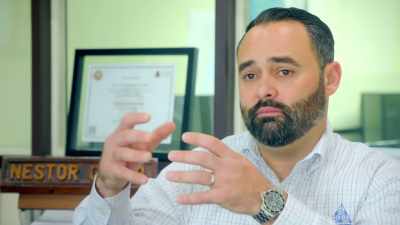
Bryan Verrall explains the process known
as slip form. Silos were made in one piece,
where the whole thing Silos were made in one piece,
where the whole thing went up in the air
as they poured until
the desired height and the walls were
about a foot thick. [narrator]
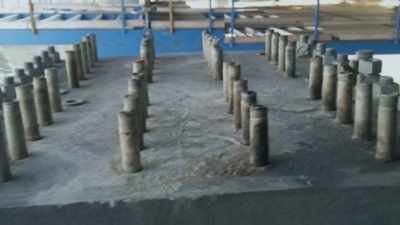
In slip form construction, the structure
isn't built in sections. Instead, concrete is poured
into a vertical mold, with the liquid rising
slowly enough
for the growing walls to support the weight above. Once fully cured,
the continuous
concrete structure is incredibly strong
and has no joints
to create weak points. is incredibly strong
and has no joints
to create weak points. Which is why it took
an awful lot to blow it up
Another possible factor
is the precise way this structure was built. After working at the silo
for more than 20 years and witnessing its strength,
Bryan Verrall explains the process known
as slip form. Silos were made in one piece,
where the whole thing Silos were made in one piece,
where the whole thing went up in the air
as they poured until
the desired height and the walls were
about a foot thick. [narrator]
In slip form construction, the structure
isn't built in sections. Instead, concrete is poured
into a vertical mold, with the liquid rising
slowly enough
for the growing walls to support the weight above. Once fully cured,
the continuous
concrete structure is incredibly strong
and has no joints
to create weak points. is incredibly strong
and has no joints
to create weak points. Which is why it took
an awful lot to blow it up
Full Transcript
00:00:01.000 --> 00:00:03.766
[narrator]
Another possible factor
is the precise way
00:00:03.766 --> 00:00:05.467
this structure was built.
00:00:05.467 --> 00:00:08.467
After working at the silo
for more than 20 years
00:00:08.467 --> 00:00:12.002
and witnessing its strength,
Bryan Verrall explains
00:00:12.267 --> 00:00:16.067
the process known
as slip form.
00:00:16.067 --> 00:00:17.919
Silos were made in one piece,
where the whole thing
00:00:17.919 --> 00:00:18.006
Silos were made in one piece,
where the whole thing
00:00:18.866 --> 00:00:21.766
went up in the air
as they poured until
the desired height
00:00:21.766 --> 00:00:24.006
and the walls were
about a foot thick.
00:00:24.666 --> 00:00:26.267
[narrator]
In slip form construction,
00:00:26.267 --> 00:00:28.866
the structure
isn't built in sections.
00:00:28.866 --> 00:00:32.009
Instead, concrete is poured
into a vertical mold,
00:00:32.967 --> 00:00:36.006
with the liquid rising
slowly enough
for the growing walls
00:00:36.666 --> 00:00:39.267
to support the weight above.
00:00:39.267 --> 00:00:42.866
Once fully cured,
the continuous
concrete structure
00:00:42.866 --> 00:00:47.919
is incredibly strong
and has no joints
to create weak points.
00:00:47.919 --> 00:00:48.067
is incredibly strong
and has no joints
to create weak points.
00:00:48.067 --> 00:00:48.006
Which is why it took
an awful lot to blow it up.
Want This Clip in HD?
Upgrade for HD/4K downloads and unlimited access. Upgrade now →
Movie Summary
With access to all phases of design and a large cast of experts, some of the great failures of engineering history are uncovered.

![[narrator] So why had
this historic dam failed
so catastrophically? - Engineering Catastrophes](https://clip.cafe/img400/narrator-so-why-had-this-historic-dam-failed-so-catastrophically.jpg)
![[narrator] The investigation
also revealed - Engineering Catastrophes](https://clip.cafe/img400/narrator-the-investigation-also-revealed.jpg)
![[narrator] When that happens
the soil above drops throug - Engineering Catastrophes](https://clip.cafe/img400/narrator-when-happens-the-soil-above-drops-throug.jpg)

![[narrator] On the surface,
the Westwood sinkhole - Engineering Catastrophes](https://clip.cafe/img400/narrator-on-the-surface-the-westwood-sinkhole.jpg)
![[narrator] As the
community mourned, - Engineering Catastrophes](https://clip.cafe/img400/narrator-as-the-community-mourned.jpg)
![[narrator] The first factor
officials would investigate
was the bear-trap gate - Engineering Catastrophes](https://clip.cafe/img400/narrator-the-first-factor-officials-would-investigate-was-the-bear-trap-gate.jpg)