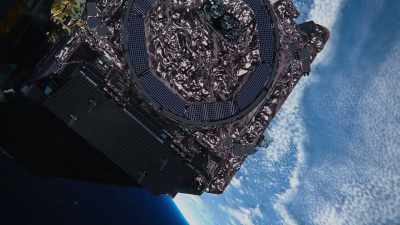
![[OPENING BRIEFCASE]](https://clip.cafe/img800/opening-briefcase.jpg)

These are some of the original concepts on, uh, what was then calledthe Next Generation...
Join the conversation
Log in or create an account to leave a comment
Log In
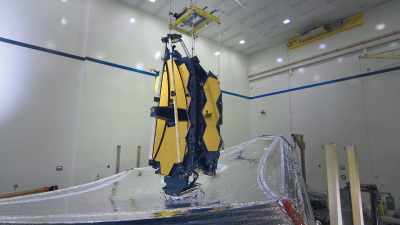
[OPENING BRIEFCASE] These are some of the original concepts on, uh, what was then called
the Next Generation Space Telescope. The bigger the mirror,
the more light you're collecting. So, to actually see first light,
you're going to have to be big. We had five... five concepts
that we looked at. This was, uh, an original one. The devil in these designs
are in the details, so it isn't until you get
to, you know, some detailed engineering that looks like this,
that you find the problems. The most obvious problem, its... its diameter is bigger than the diameter
of the rocket that carries it. So you have to fold it up. We had deployments that had
the primary mirror segments stacked, almost like a record player. And then one of the concepts that we had
was, uh, to deploy the primary mirror using two leaves
that look like a drop table, which is what we're doing now. Our preliminary design review was 2008, and that's where the telescope starts
really looking like what we have today
the Next Generation Space Telescope. The bigger the mirror,
the more light you're collecting. So, to actually see first light,
you're going to have to be big. We had five... five concepts
that we looked at. This was, uh, an original one. The devil in these designs
are in the details, so it isn't until you get
to, you know, some detailed engineering that looks like this,
that you find the problems. The most obvious problem, its... its diameter is bigger than the diameter
of the rocket that carries it. So you have to fold it up. We had deployments that had
the primary mirror segments stacked, almost like a record player. And then one of the concepts that we had
was, uh, to deploy the primary mirror using two leaves
that look like a drop table, which is what we're doing now. Our preliminary design review was 2008, and that's where the telescope starts
really looking like what we have today
Full Transcript
00:00:01.000 --> 00:00:01.096
[OPENING BRIEFCASE]
00:00:02.046 --> 00:00:04.629
These are some of the original concepts
00:00:04.712 --> 00:00:08.299
on, uh, what was then called
the Next Generation Space Telescope.
00:00:09.003 --> 00:00:12.679
The bigger the mirror,
the more light you're collecting.
00:00:12.762 --> 00:00:16.516
So, to actually see first light,
you're going to have to be big.
00:00:16.599 --> 00:00:18.977
We had five... five concepts
that we looked at.
00:00:19.999 --> 00:00:20.645
This was, uh, an original one.
00:00:21.354 --> 00:00:23.398
The devil in these designs
are in the details,
00:00:23.481 --> 00:00:28.001
so it isn't until you get
to, you know, some detailed engineering
00:00:28.111 --> 00:00:30.697
that looks like this,
that you find the problems.
00:00:30.078 --> 00:00:32.532
The most obvious problem,
00:00:32.615 --> 00:00:34.117
its... its diameter is bigger
00:00:34.002 --> 00:00:36.786
than the diameter
of the rocket that carries it.
00:00:36.087 --> 00:00:38.496
So you have to fold it up.
00:00:38.058 --> 00:00:42.834
We had deployments that had
the primary mirror segments stacked,
00:00:42.917 --> 00:00:44.627
almost like a record player.
00:00:44.711 --> 00:00:48.965
And then one of the concepts that we had
was, uh, to deploy the primary mirror
00:00:49.002 --> 00:00:51.301
using two leaves
that look like a drop table,
00:00:51.384 --> 00:00:52.076
which is what we're doing now.
00:00:52.844 --> 00:00:55.555
Our preliminary design review was 2008,
00:00:56.139 --> 00:01:00.226
and that's where the telescope starts
really looking like what we have today.
Want This Clip in HD?
Upgrade for HD/4K downloads and unlimited access. Upgrade now →
Movie Summary
Follows a team of engineers and scientists in an ambitious mission to launch the James Webb Space Telescope and take the next giant leap in the understanding of the universe.


![[AMBER] NASA actually retrofitted - Unknown: Cosmic Time Machine](https://clip.cafe/img400/amber-nasa-actually-retrofitted.jpg)
![[MIKE CHUCKLING] It's the size
of a three-story building, - Unknown: Cosmic Time Machine](https://clip.cafe/img400/mike-chuckling-its-the-size-of-a-three-story-building.jpg)
![[AMBER] All of these years
we've put into getting this telescope - Unknown: Cosmic Time Machine](https://clip.cafe/img400/amber-all-of-these-years-weve-put-into-getting-telescope.jpg)
![[SIRENS WAILING] - Unknown: Cosmic Time Machine](https://clip.cafe/img400/sirens-wailing-s116.jpg)
![[MIKE] Do I like launches? Well... - Unknown: Cosmic Time Machine](https://clip.cafe/img400/mike-do-i-like-launches-well.jpg)

![[THOMAS] I write both speeches by myself. - Unknown: Cosmic Time Machine](https://clip.cafe/img400/thomas-i-write-both-speeches-by-myself.jpg)
![[MAN IN FRENCH] All propulsion parameters
are normal. Trajectory is normal. - Unknown: Cosmic Time Machine](https://clip.cafe/img400/man-in-french-all-propulsion-parameters-are-normal-trajectory-normal.jpg)
![[THOMAS IN ENGLISH] "Today's launch
was not successful, - Unknown: Cosmic Time Machine](https://clip.cafe/img400/thomas-in-english-todays-launch-was-not-successful.jpg)
![[CLANKS] - Unknown: Cosmic Time Machine](https://clip.cafe/img400/clanks-s9.jpg)
![{\an8}[MAN IN FRENCH] ESC shutdown. - Unknown: Cosmic Time Machine](https://clip.cafe/img400/an8-man-in-french-esc-shutdown.jpg)
![[MAN IN FRENCH]
Separation of the Webb Telescope. - Unknown: Cosmic Time Machine](https://clip.cafe/img400/man-in-french-separation-of-the-webb-telescope.jpg)
![[BOTH CHUCKLING] - Unknown: Cosmic Time Machine](https://clip.cafe/img400/both-chuckling-s9.jpg)